A Senior Physical Therapist Says This Is the Bathroom Detail Adult Children Miss — Until It’s Too Late.
She’s spent 22 years in senior rehabilitation watching what families never see coming: not the fall itself, but the long, slow, painful year that follows it. Here’s the bathroom item she now tells every adult child to put in place before the first call to the hospital.

Karen Wexler has spent 22 years in the rehab clinic where seniors learn to walk again after a fall. What she sees there is what most families never imagine until it’s already happening.
Karen Wexler is not the kind of physical therapist who scares her patients. After 22 years working with seniors in rehabilitation, she has learned that fear doesn’t help people walk again. What helps is patience, repetition, and small wins, week after week. So when she talks about the part of her job that haunts her, she talks about it quietly.
“The fall is not the medical event we’re actually treating,” she says. “The fall is just the trigger. What we’re treating is everything that comes after.”
That’s the part most families don’t see coming. They picture the bathroom fall, and they picture the broken wrist or the bruised hip. They picture a hospital visit, maybe a cast, maybe a few weeks of recovery. Then back to normal.
What they don’t picture is the year that follows.
The four months of rehab three days a week. The walker that becomes permanent. The driver’s license that quietly goes unrenewed. The bedroom that gets moved to the first floor because the stairs are no longer safe. The home aide whose visits get longer and longer. The slow, almost invisible erosion of independence that begins with a single moment in a wet bathroom — and that, more often than families want to believe, never fully reverses.
That’s what Karen sees in her clinic every Monday morning. And it’s the reason that for the last two years, she has been quietly telling every adult child she meets the same thing: do something about the bathroom now, before you need to. See the bathroom safety bar Karen recommends
What Karen Sees That Families Don’t
“Most families think the worst-case scenario is that their parent falls and breaks a hip,” Karen says. “That’s not the worst case. The worst case is what we call the cascade.”
The cascade is the chain of events that follows a serious fall in someone over 65. A broken hip means surgery. Surgery means immobility. Immobility means muscle loss, especially in the legs and core, at the rate of about 1% per day. Two weeks in a hospital bed, and the patient has lost roughly a quarter of the strength they need to walk safely on their own. The hospital sends them to a rehab facility. The rehab facility tries to rebuild what was lost. Sometimes it works. Often, it doesn’t fully work.
According to the National Council on Aging, nearly half of all older adults who fall never return to their pre-fall level of mobility. They walk slower. They use canes or walkers they didn’t need before. They give up driving, gardening, the stairs. They become the version of themselves that they had hoped to delay being for another decade.
“The patients who break my heart aren’t the ones who come in here unable to walk. They’re the ones who, in the months before their fall, told their family they didn’t need anything in the bathroom. They were proud, and they were independent, and they were wrong. And by the time they get to me, the question isn’t whether they could have prevented this. It’s how much of their old life we can still recover.”
— Karen Wexler, Physical Therapist, 22 years in senior rehabilitationThe Patient Who Changed How Karen Talks To Families
The patient Karen still thinks about most was named Joyce. Seventy-three. Retired teacher. Lived alone in a tidy little house in the suburbs.
Joyce came in for what was supposed to be a six-week hip-recovery program after a fracture. She ended up in Karen’s clinic for nine months. On her first visit, when Karen asked her how the fall had happened — the standard intake question — Joyce told her the truth.
She had been getting out of the shower. She had felt herself slipping. She had reached for the towel bar.
The towel bar had come out of the wall.
Karen has heard versions of that sentence so many times now that she has stopped being surprised by it. The towel bar. The toilet paper holder. The decorative shelf next to the sink. Bathroom fixtures that look solid and feel solid and are not, under any circumstances, designed to hold body weight. Drywall anchors are not load-bearing. Tile screws are not load-bearing. Towel bars are decorative hardware.
Joyce had spent thirty-two years in her house. She had never once thought about whether the towel bar could hold her weight, because she had never once needed it to.
“After Joyce,” Karen says, “I started telling every adult child who came into my clinic the same thing. The towel bar will not hold them. The toilet paper holder will not hold them. The wall will not hold them. They need something that will hold them, and they need it before they need it, not after.”
What Karen Started Recommending
For most of Karen’s career, the answer to bathroom safety was a drilled-in grab bar — the same kind hospitals install. Anchored into a wall stud, properly placed, those bars work. The problem is everything around getting one installed: locating the stud behind the tile, hiring a handyman, paying $400 to $700 for the labor, dealing with cracked grout, and convincing a parent who has lived in their house for forty years that yes, they need to drill a hole in their bathroom.
Most families don’t make it through that process. Karen has watched it happen for two decades. The contractor quote comes back. The mother says no, she doesn’t want her bathroom to look like a hospital. The adult child gives up and tells themselves they’ll figure it out next month. And then six months later, the parent is in Karen’s clinic learning to use a walker. Check the no-drill option here
About two years ago, that started changing. Adult children began coming into her clinic and asking her about a different product they had seen online. It didn’t require drilling. It didn’t require a contractor. It installed in under a minute. It was called Stable Grip.
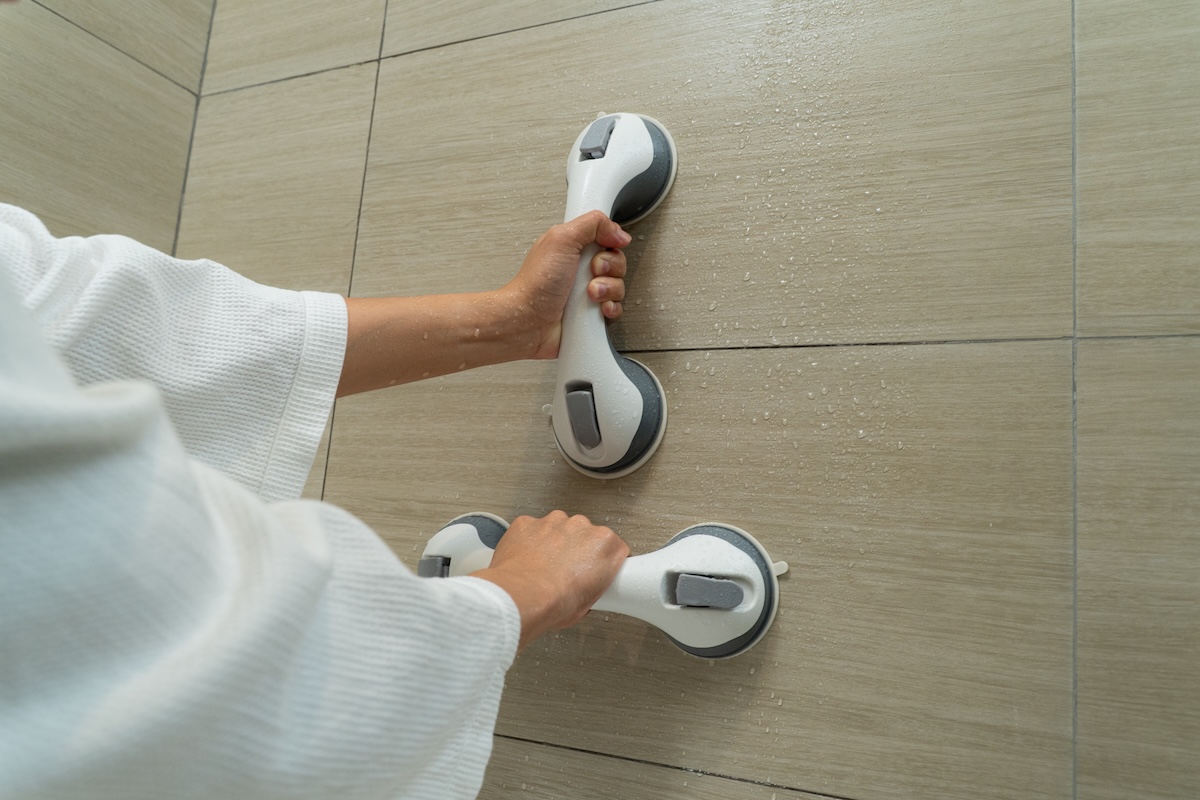
“I was skeptical at first,” Karen says. “I had seen the cheap suction-cup grab bars at drugstores for years. They had a deserved reputation for failing. So when families started asking me about this newer product, I wanted to test it myself.”
What she found, when she actually put one on her own bathroom wall and yanked on it as hard as she could, surprised her.
Stable Grip uses what’s called a mechanical locking cam — a quarter-turn lever on each suction cup that physically pulls the rubber pad against the tile and creates a vacuum seal that can’t release until the lever is reversed. That’s different from the older drugstore suction bars, which rely on simple atmospheric pressure and slowly fail over time. Each cup also has a red/green indicator window that tells you, at a glance, whether the seal is currently engaged.
“It’s the indicator that sold me,” Karen says. “The reason cheap suction bars are dangerous is not that they fail. Everything fails eventually. The reason cheap ones are dangerous is that you can’t tell when they’ve failed. The seal weakens overnight, you go to grab the bar in the morning, and it’s not there. The indicator window solves that problem completely.”
Stable Grip is rated to hold up to 240 pounds on a properly prepared smooth surface — glazed tile, glass, fiberglass, acrylic, or polished stone. It installs in about thirty seconds with no tools, leaves no marks or holes, and can be moved or taken with you when you travel. See current Stable Grip availability
“What I love about it,” Karen says, “is that it solves the part of the problem that I’ve been losing for twenty years — the part where the parent says no because they don’t want their bathroom to look like a hospital. Stable Grip doesn’t look like a hospital. It looks like something a design-conscious person would put in their bathroom. And it goes up so fast that there’s nothing to argue about. By the time the parent has finished asking what it is, it’s already on the wall.”
Ships from a U.S. warehouse · 30-day money-back guarantee · No tools required
What Karen Tells Adult Children Now
Karen’s clinic gets referrals from local hospitals every day. New patients. New families. Same question, asked a slightly different way each time: Could we have prevented this?
The honest answer, almost always, is yes. Maybe. Probably. A grab bar in the bathroom, properly placed, would have given the patient something to hold onto in the moment when the towel bar moved. A grab bar costs forty dollars. The nine months of physical therapy that follow the fall cost thirty thousand. The math, in retrospect, is brutal. Check Stable Grip pricing
But Karen has stopped having that conversation after the fall. She has started having it before.
“Every time I meet an adult child of a senior — in the grocery store, at a school event, anywhere — I tell them the same thing. The bathroom is the most dangerous room in the house. The towel bar will not hold them. There is a thirty-dollar product that takes thirty seconds to install and could prevent the worst year of your parent’s life. Do it now, before you need to.”
“I have stopped counting the families who told me they were going to do something about it next month. Next month is the wrong month. The right month is the one you’re already in.”
What Adult Children Are Saying
“My 78-year-old mother kept refusing to let us put a permanent grab bar in her shower because she didn’t want her bathroom to look like a hospital. This was the compromise we needed. She uses it every morning now and I sleep better at night.”
“My dad slipped in the shower last spring and spent six weeks in rehab. We put Stable Grip in his bathroom the day he came home. Since then, he hasn’t needed help once getting in or out. For our family, that’s everything.”
“I yanked on it with both hands before my mother ever used it. It did not move. That’s the whole story. It simply does not move.”
“I’m a home health aide. The red and green indicator is what sold me — you can tell at a glance if it’s safe to grab. The cheap suction bars from years ago were dangerous because you couldn’t tell when the seal was failing. This solves that completely. I’ve recommended it to four of my clients now.”
“I expected it to look medical or ugly. It doesn’t. My mother looked at it and said it looked intentional — like something she would have chosen herself. That mattered to her, and so it mattered to me.”
What Stable Grip Actually Does
The Conversation Karen Wants Every Adult Child To Have
“If you have a parent over 65,” Karen says, “there is a conversation you have not had yet, and you know it. You know it because every time you visit them, you look around their bathroom and you think to yourself, I should really do something about that.”
“The reason you haven’t done it isn’t because you don’t care. It’s because the alternatives have always been hard. Drilling into tile is hard. Hiring a contractor is hard. Convincing your mother that her bathroom needs a permanent grab bar is the hardest part of all. So you keep meaning to.”
“What I want every adult child to know is that there’s a version of this that isn’t hard anymore. It costs forty dollars. It takes thirty seconds. It doesn’t damage anything. It doesn’t require anyone’s permission. You can put it up before your parent has even noticed it’s in your hand. And it could prevent the single most expensive, most painful, most life-altering injury that your parent will ever experience.” Try it before there is a fall
“That’s the conversation. That’s the whole conversation. Do it now, before you have to do it after.”
A safer bathroom in under 60 seconds — for the people who matter most.