I Almost Hired A Contractor To Drill A Grab Bar Into My Mother’s Bathroom — Then I Tested The $40 Alternative First.
My mother is 76. She’d had a close call after stepping out of the shower last Christmas. I had two weeks to figure out a solution — and not a lot of patience for products that only sort of work. Here’s exactly what I tested, what failed, and what I bought in the end.

For most adult children with an aging parent, bathroom safety becomes a real conversation after the first close call. Here’s the research my mother needed me to do.
My mother is the kind of woman who would never admit to being scared of anything. At 76, she still drives, still hosts Sunday dinner, still grows tomatoes in pots on her back patio. So when she called me on a Tuesday morning in late December and said, very casually, that she’d had “a little moment” getting out of the shower the day before, I knew exactly what that meant. She had nearly fallen. And she had spent twenty-four hours trying to convince herself it wasn’t worth telling anyone about.
I asked what happened. She paused for a long time. Then she said: “I reached for the towel bar, and the towel bar moved.”
I sat down on my couch.
That phrase — the towel bar moved — is one I think about a lot now. Because most of us never think about whether our bathroom hardware is rated to hold body weight. It looks solid. It feels solid. Until the one moment when our balance fails and we grab for it. And then we find out, often too late, that towel bars are decorative. They are anchored to drywall. They are not designed to hold a person.
I told my mother I was going to do some research. I told her I wanted to put something in her bathroom that was designed to hold a person. She said okay, but only if it didn’t look like a hospital, and only if I didn’t turn it into a project that took over her whole life.
I had two weeks before I flew home for Christmas. I started that night.
Option 1: A Drilled-In Grab Bar (What I Almost Did)
The first thing every safety guide tells you is to install a proper grab bar — the kind hospitals use. The problem is that to do it correctly, the bar has to be anchored into a wall stud, not just the tile. Tile won’t hold weight. Drywall won’t hold weight. You need wood behind the wall. And finding a stud behind tile usually means hiring a handyman or a contractor.
I called three local contractors. The quotes I got back ranged from $400 to $700 for a single bar in a single bathroom. Not because the bar itself was expensive — the hardware part runs $50 to $150 — but because of the labor: drilling through tile carefully (without cracking it), locating the stud, sealing the holes, cleaning up.
I almost said yes to a contractor that quoted me $475 and could do it the following Tuesday. The only reason I didn’t is that my sister called me that night and asked what I was going to do. Check the $40 alternative here
“Don’t pay $475 for a single bar yet,” she said. “Try the no-drill one first. They’re thirty-something dollars. If it doesn’t work, then call the contractor.”
— My sister, who is more practical than I amI’ll be honest: I was skeptical. I had seen the cheap suction-cup grab bars at drugstores for years — the kind with the green and red indicator. They had a reputation, in our family at least, of being the kind of thing you bought once and threw out a month later because it kept popping off the wall.
But my sister is the one who actually does the research in our family. So I ordered one. And I ordered a cheaper drugstore version too, because I wanted to see, side by side, whether the “new” ones were really any different from the old ones.
Option 2: The $19 Drugstore Suction Bar (Which Failed Within A Day)
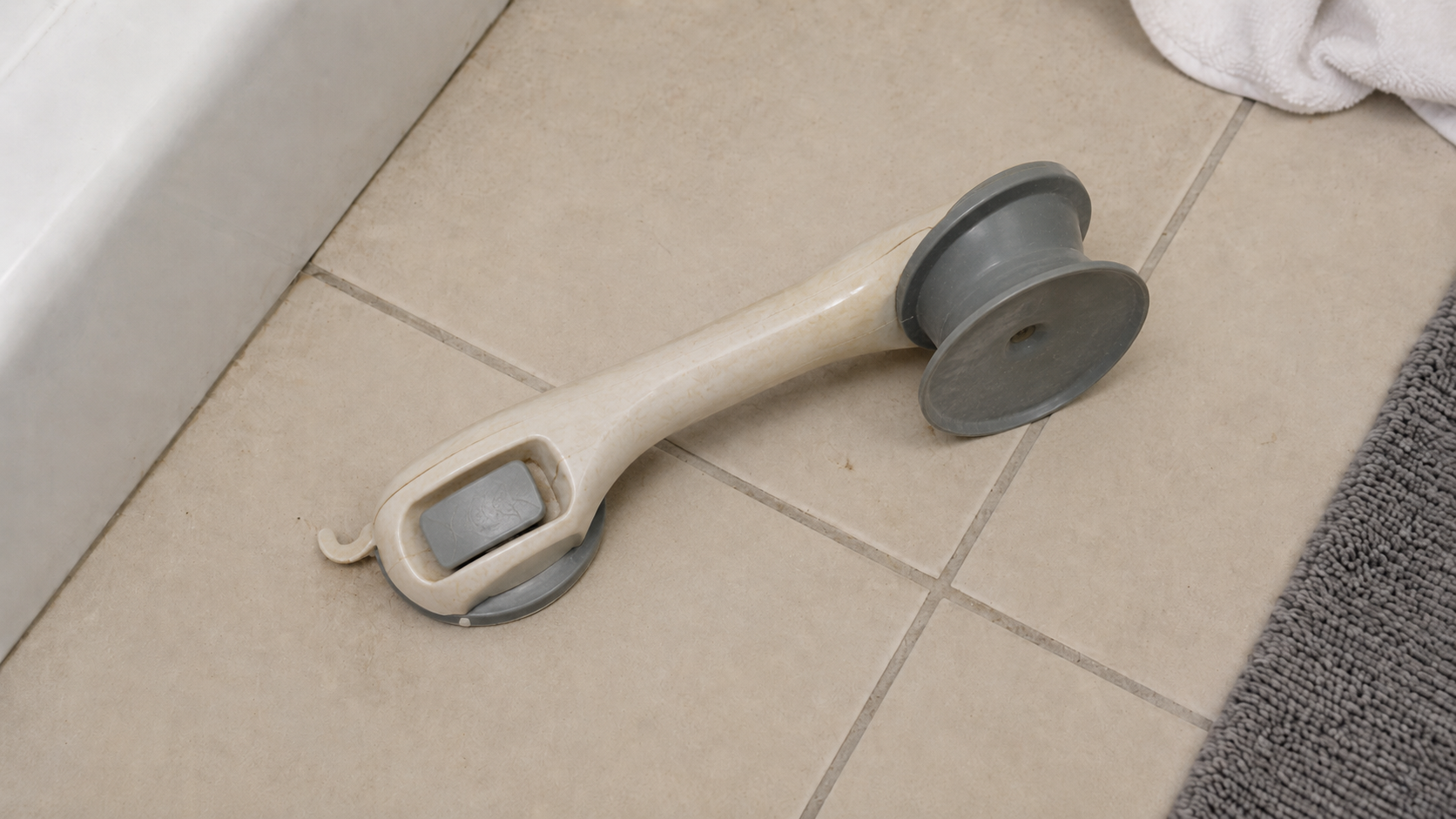
The cheap one arrived in 24 hours. I installed it in my own bathroom shower (I wanted to test it first before sending anything to my mother). I pressed the suction cups against the tile, flipped the levers, and gave it a tug.
It seemed solid. The little indicator window was green. I left it there.
Eighteen hours later it was on the floor of the shower. Nothing dramatic. The seal had just slowly given way overnight, after a single hot shower had loosened the cups. The indicator window had quietly turned red sometime in the middle of the night, and nobody had been there to notice.
That, in a sentence, is the problem with the cheap suction-cup bars: they don’t fail loudly. They fail slowly, while you’re asleep, and you only find out about it when you go to grab for them and they’re no longer there.
I threw the cheap one out the next morning. And I almost gave up on the whole no-drill category — until I unboxed the second one, the one my sister had recommended.
Option 3: Stable Grip (Which Refused To Move)
The Stable Grip arrived in a small flat box. The bar itself is about 12 inches long, with a large suction cup on each end. Each cup has a quarter-turn lever that locks the suction in place — not just by pressure, but by mechanically pulling the rubber pad against the wall to create a vacuum seal. It’s a different mechanism than the cheap drugstore version. The cheap one relies on suction pressure alone. Stable Grip relies on a mechanical vacuum lock that physically cannot release until you twist the lever back.
It also has the red/green indicator window. But the indicator does something different here. On the cheap one, the green meant “the suction is currently holding.” On Stable Grip, the green means “the mechanical seal is engaged.” If the indicator turns red, the seal hasn’t weakened — it’s telling you the cam needs to be re-engaged. It’s a fundamentally different design.
I installed it on the same shower tile as the failed cheap one. Pressed it flat. Twisted both levers. Felt the suction click into a locked position with an audible little snap. See how Stable Grip works
And then I did the test that mattered: I pulled on it. With both hands. Hard. The way you’d pull on it if you were genuinely falling.
“It did not move. Not a millimeter. Not a creak. I yanked on it for ten seconds with my full body weight, and the bar was as solid as if I’d screwed it directly into a stud. I sat down on the edge of the tub and stared at it.”
— Sarah Mendel, SafeStride ReportI left it on the wall for seven days as a test. I took multiple hot showers. I splashed water at the cups directly. I bumped it. The indicator stayed green for the entire week. When I finally twisted the levers off — out of pure curiosity — it released with a soft hiss and lifted clean off the tile. No marks. No residue. No holes. Nothing.
I ordered three more that night. One for my mother’s shower. One for next to her toilet. One I kept in my own travel bag. See current availability
Ships from a U.S. warehouse · 30-day money-back guarantee · No tools required
Why This One Actually Works (When The Cheap Ones Don’t)
I asked an occupational therapist friend of mine to look at both bars. She had the same reaction I did when she compared them side by side.
The cheap suction grab bar relies on simple atmospheric pressure to hold against the wall. When you push it on, you’re creating a vacuum behind the cup, and the air pressure outside pushes the cup against the wall. That works for a while. But every temperature change, every drop of water that gets behind the seal, every time someone bumps the bar — the seal weakens. You can’t see it weakening until it fails.
Stable Grip uses what’s called a mechanical locking cam. The lever doesn’t just press the cup against the wall — it physically pulls the center of the rubber pad backward, like a tiny suction pump, while sealing the edges against the tile. The result is a vacuum that stays locked even if the temperature shifts, even if water gets near the seal, even if someone bumps it. It can only release if you reverse the lever. There is no “slow leak” failure mode like the cheap version.
It’s the difference between a suction cup that is passively holding (and quietly failing) and one that is actively locked (and waiting to be deliberately released).
“The mechanical lock is the entire ballgame. If you can’t see how the seal is engaged, you can’t trust it. If you can see the lever is engaged, you can.”
The 30-Second Install (My Mother Did It Herself)
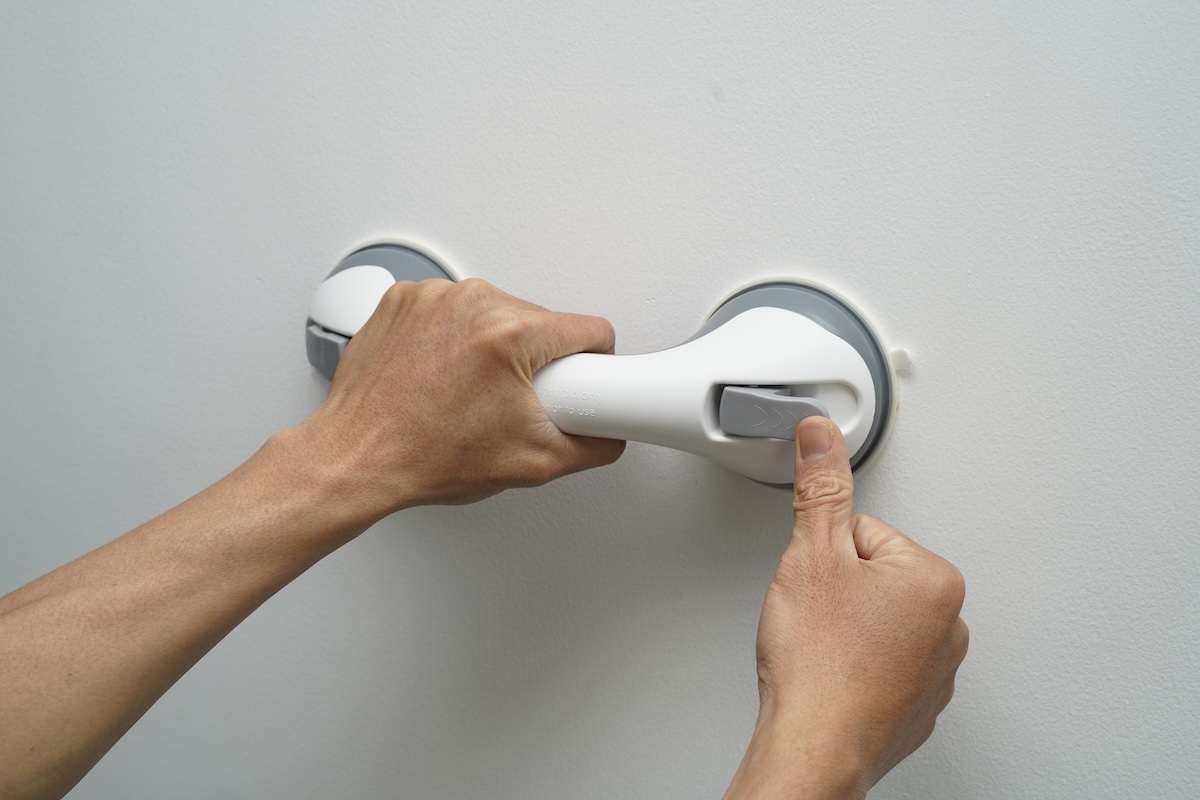
- Wipe the tile clean and dry. Any smooth, glazed surface works — tile, glass, fiberglass, acrylic, marble. Ten seconds with a dry cloth.
- Press the bar flat against the wall. Position it where the natural handhold would be — beside the shower entry, next to the toilet, along the inside of the tub.
- Twist both levers down until they click. You feel and hear the seal engage. The vacuum is locked.
- Tug-test with both hands. Pull hard. If it doesn’t move, you’re done. If it does, reposition and try again.
My mother did all of this herself. While her coffee was brewing. Those were her exact words to me on the phone the day after it arrived: “The coffee maker took longer than the bar did.”
Side-By-Side: What I Actually Compared
| Option | Cost | Install | Damages Wall | Works Renting |
|---|---|---|---|---|
| Stable Grip | ~$40 | ~30 sec | No | Yes |
| Drilled-in grab bar (contractor) | $400–$700 | 1–2 hr | Yes | No (lease) |
| Cheap drugstore suction bar | $15–$25 | 2 min | No | Yes — but failed in 18hrs |
| Standard towel bar (unsafe) | $30–$80 | N/A | Yes | Not load-bearing |
The reason Stable Grip won this comparison wasn’t that it was the cheapest. It was that it was the only one that actually worked for what I needed: something that would hold body weight, install in seconds, leave no damage, work in a rental, and reliably tell me whether it was currently safe to use. Check Stable Grip pricing
30-Day Money-Back Guarantee
If Stable Grip doesn’t hold the way it’s described — or if your tile isn’t smooth enough for the seal — you can return it within 30 days for a full refund. No questions, no restocking fee. Ships and returns from a U.S. warehouse.
What Surprised Me Most (And It Wasn’t The Safety Part)
About a month after I sent my mother her three Stable Grips, I went home for a long weekend. The first thing I noticed was that she had moved one of them to her guest bathroom — the one I always use when I visit.
“I figured you’d feel safer with one in there,” she said.
I’m 47. I don’t need a grab bar. But here’s the thing: I used it. Every time I got in or out of the shower that weekend, I rested a hand on it. Not because I needed it. Because knowing it was there, knowing I could grab it instantly if the tile got slick, made me realize how often I actually do reach for the wall in a wet bathroom. We all do it. We just don’t notice we’re doing it until something we can actually rely on is there.
That’s the part I didn’t expect. It wasn’t a product for old people. It was a product that everyone in a wet bathroom subconsciously already wanted.
What Stable Grip Actually Does
What Other Families Are Saying
“My 78-year-old mother kept refusing to let us put a permanent grab bar in her shower because she didn’t want her bathroom to look like a hospital. This was the compromise we needed. She uses it every morning now and I sleep better at night.”
“I yanked on it with both hands before my mother ever used it. It did not move. That’s the whole story. It simply does not move.”
“I’m a home health aide. The red and green indicator is what sold me — you can tell at a glance if it’s safe to grab. The cheap suction bars from years ago were dangerous because you couldn’t tell when the seal was failing. This solves that completely. I’ve recommended it to four of my clients now.”
“I take it with me when I travel. Slippery hotel tubs are honestly terrifying once you hit a certain age. This goes on the wall in 30 seconds and comes off without leaving anything behind. It’s become part of my packing list.”
“I expected it to look medical or ugly. It doesn’t. My mother looked at it and said it looked intentional — like something she would have chosen herself.”
“What If My Bathroom Tile Is Different?”
This was the only real risk I felt when I ordered it. Stable Grip works on smooth, non-porous surfaces — glazed ceramic or porcelain tile, glass shower walls, fiberglass, acrylic, polished stone. It will not hold reliably on textured tile, painted drywall, unsealed natural stone, or grout lines.
The good news is the indicator window tells you within seconds of installation whether the seal is engaged. If the window doesn’t turn green, it isn’t holding. You haven’t broken anything, you haven’t damaged the wall, you just lift the bar off and try a different spot — or, in the rare case where no spot in the bathroom is smooth enough, you send it back. The 30-day money-back guarantee exists specifically for this reason.
That’s the part that made me actually order it. Worst case, it didn’t work in my mother’s bathroom and I shipped it back. Best case, it worked and I had solved the problem for $40 instead of $475. The math wasn’t complicated. Try it before hiring a contractor
What I Tell Other Adult Children Now
I’ve had this conversation with at least eight different friends in the last six months. Every single one has an aging parent. Every single one has the same vague worry about their parent’s bathroom. None of them have done anything about it. They all say some version of the same sentence: “I keep meaning to.”
If you have a parent over 65 — or you yourself are over 65 — the bathroom is the one room in the house that statistically is most likely to send you to the emergency room this year. The thing that makes it dangerous isn’t complicated. It’s a wet smooth surface, hard tile underneath, and nothing solid to hold onto when you slip. The fix isn’t complicated either. It just has to be something solid you can actually grab.
For my mother, the answer turned out to be a $40 bar that took thirty seconds to install. I almost spent $475 to learn the same thing the hard way. I’m glad I didn’t.
A safer bathroom in under 60 seconds — for the people who matter most.